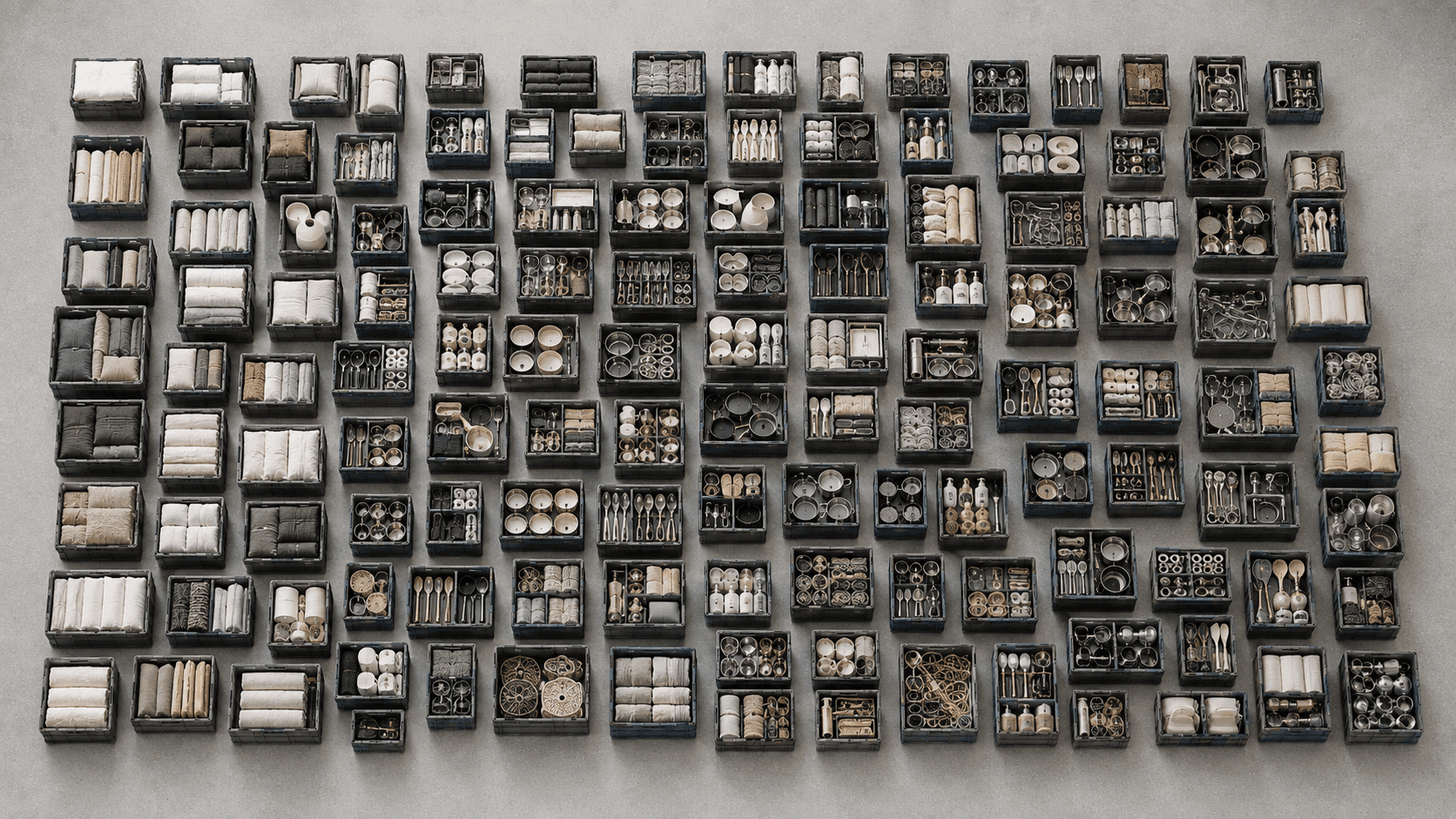
Accept reality. Structure it intelligently.
Furnished properties are naturally detailed.
They contain furniture, appliances, kitchenware, decoration, linens, fixtures, surfaces, and many smaller objects that support everyday life.
That detail is part of their value.
The goal should not be to simplify the property by ignoring what is actually there.
The goal is to make the real property understandable, reusable, and inspectable.
Mono follows a simple principle:
Do not remove detail to create order. Structure the detail so other people can use it.
Artificial simplicity creates blind spots.
Traditional inspection forms often begin with a predefined checklist.
A room might be reduced to generic questions:
Are the walls in good condition?
Are the appliances working?
Is the room clean?
This keeps the form short by removing context.
Which appliances? What furniture? Which existing marks or defects?
That may work while the same person manages the same property from memory. It becomes less reliable when tenants, new staff, external inspectors, or property managers become involved.
Mono takes the opposite approach: build the real inventory first. The inventory itself becomes the inspection guide.
Structure the property as it exists.
In Mono, every relevant part of the property can become an inventory record.
This includes movable items such as furniture, kitchenware, and decoration, as well as immovable items such as walls, windows, and built-in appliances.
Records are grouped into spaces that reflect the actual property.
A space can be a room, but it can also be a more precise operational area such as Upper cabinet left, Wardrobe, or Terrace storage.
The purpose is to preserve enough spatial context that another person can understand where an item belongs and find it without relying on prior knowledge.
Knowing is not the same as structuring.
Owners often know their properties extremely well.
They know which drawer contains the cutlery, where the spare bedding is stored, and which chair already has a scratch.
But this knowledge is fragile when an employee leaves, a tenant verifies the inventory, or items are moved or replaced.
If the property only makes sense to the person who created it, the inventory is not yet operationally reusable.
Embrace the Chaos transfers that knowledge from memory into a visual structure that other participants can follow.
The 20-item soft ceiling.
Accepting reality does not mean placing every object in one enormous room list.
Through building Mono and working with detailed furnished properties, we noticed a practical pattern:
Spaces containing more than roughly 20 items often become noticeably harder to inspect.
This is not a technical limit. It is a rule of thumb.
Below it, items are easier to locate, issues stand out, and inspections remain fast.
Above it, inspectors spend more time searching, visual signals compete for attention, and inspection time increases.
Subdivide without reducing detail.
When a space becomes difficult to navigate, the solution should not be to track fewer items.
The better solution is to divide it into smaller, recognizable areas.
Instead of one kitchen containing 105 records:
Cutlery → Drawer A
Pots and pans → Lower cabinet left
Glasses and mugs → Upper cabinet right
Plates and serving items → Upper cabinet left
Cleaning items → Sink cabinet
The inventory still represents the real kitchen.
No items have been removed.
The structure has simply been improved so another person can navigate it.
Space design should follow real movement.
Spaces should not be created only because they look tidy inside an application.
They should support the way someone physically moves through the property.
A useful structure may follow rooms, furniture that contains items, or the normal inspection route.
The correct structure depends on the property.
A minimalist apartment may need only a few broad spaces. A fully stocked kitchen may benefit from individual cabinets and drawers. A decorated living room may be divided into seating, media, and shelving areas.
Mono uses no hard space or item limits. The property determines the detail.
One structure, several uses.
A well-mapped inventory should not exist only for inventory management.
The same structure can support condition reports, internal audits, and make-ready work.
Separate structures create separate administration. If the inventory is stored in one place, the inspection checklist in another, and the report somewhere else, they will eventually stop matching.
In Mono, the current inventory determines what can be inspected. The inspection updates the same inventory, and the resulting condition report follows the same visual structure.
When the property changes, the future inspection guide changes with it.
Inspect from reality. Narrow with intent.
Building inspections from the real inventory does not mean every inspection must review every item.
Every item assigned to a space is included by default. An inspection recipe can then narrow the scope by space or category, minimum recorded price, or when items were last reviewed.
Price filters apply only to movable items with a recorded price. Immovables and unpriced movables remain included.
Individual items can also be marked as mandatory or excluded.
The complete inventory remains the source of truth, while each inspection focuses on what matters at that moment.
The structure can improve over time.
Embrace the Chaos is not a one-time setup decision.
Mono records the number of items per space, condition and cleanliness distributions, and inspection time in total and per space.
If one space repeatedly takes too long, contains many overlooked items, or becomes difficult for tenants and staff to navigate, it may need to be divided differently.
The inventory not only describes the property.
It can also provide feedback on whether the property has been mapped well.
Preserve the detail. Improve the structure.
A furnished property should not need to be reduced to a hotel room before it can be inventoried properly.
Document the real spaces.
Document the real items.
Preserve the visual context.
Subdivide where complexity begins to obstruct orientation.
The result is not artificial order.
It is organized reality—detailed enough to be accurate and structured enough to remain usable over time.